
General Information about Albuterol
One of the benefits of Ventolin is its minimal unwanted effects, making it a secure option for each children and adults. The most typical unwanted side effects embody tremors, headaches, and palpitations, which are gentle and normally resolve on their very own. However, in rare circumstances, extra critical side effects such as allergic reactions and irregular heartbeats can occur. As with any medication, it's important to use Ventolin beneath the supervision and steering of a physician.
Aside from its use in managing bronchial asthma, Ventolin is also prescribed to sufferers with continual obstructive bronchitis. This condition, also known as COPD, is a progressive lung disease that causes difficulty in respiratory and is commonly related to persistent bronchitis and emphysema. Ventolin helps COPD patients by opening up their airways, making it easier for them to breathe and reduce the frequency and severity of exacerbations.
In conclusion, Albuterol, also referred to as Ventolin, is a valuable medication in the management of asthma and continual obstructive bronchitis. Its ability to advertise bronchodilation and supply fast aid of signs makes it a go-to selection for patients and healthcare providers. With its minimal unwanted effects and ease of use, it has considerably improved the lives of these living with these respiratory circumstances. If you might have bronchial asthma or COPD and are experiencing difficulty managing your signs, speak to your doctor about Ventolin. It may be the solution you've been looking for.
Albuterol, higher recognized by its brand name Ventolin, is a commonly used medication for the therapy of asthma and continual obstructive bronchitis. It belongs to a category of medicine referred to as beta-2 adrenergic receptor agonists, which work by stress-free and opening up the airways within the lungs. This permits for simpler breathing and relief from symptoms such as wheezing, coughing, and shortness of breath.
One of the commonest remedies for asthma is using an inhaler, and Ventolin is a well-liked selection amongst sufferers and medical doctors alike. It comes in the form of an inhaler or nebulizer and is designed to deliver a precise amount of treatment directly to the lungs. This targeted delivery system allows for quicker and simpler reduction of signs compared to oral medications.
Asthma is a persistent respiratory situation that impacts hundreds of thousands of individuals worldwide. It is characterised by inflammation and narrowing of the airways, making it tough to breathe. Symptoms can vary from mild to extreme and can be triggered by a selection of components such as allergens, train, chilly air, and stress. In some cases, asthma may be life-threatening and requires immediate medical attention.
Asthma sufferers can use Ventolin as a rescue treatment to rapidly alleviate symptoms during an asthma assault. It works by binding to beta-2 receptors in the easy muscles of the lungs and activating them, which causes the muscles to relax and the airways to widen. This permits for increased airflow and better respiratory. In addition to its quick-acting impact, Ventolin additionally has a long-lasting impact, making it a preferred selection for managing asthma signs.
Fluid from cystic hygroma and pleural effusion contains lymphocytes asthma definition deutsch order albuterol from india, and these cells can be analyzed, using cytogenetic or molecular techniques, within the time frame of a few days. In one small series, three out of four cystic hygroma analyses showed aneuploidy (trisomy 21, monosomy X) (Costa et al. The attraction, in principle, is of diagnosis as early as 5 weeks, and a (relatively) noninvasive procedure. Cells of maternal origin outnumber fetal cells at a ratio of 2000:1 (Imudia et al. Fetal cells are then separated with a magnet and subjected to molecular analysis (Fritz et al. Rothman (1988), in her book the Tentative Pregnancy, is particularly critical of what she viewed as a medicalized distortion of the normal process of being pregnant. Hodge (1989) describes her personal experience of Waiting for the Amniocentesis, and we reproduce her letter in full: I drafted the following letter to the editor one week before I expected to hear the results of my amniocentesis: "I am 40 years old and 19 weeks pregnant with what will presumably be my third child. When I teach medical students about amniocentesis, I occasionally mention the difficulty for the woman of having to wait until well into the second trimester to receive her results. Pregnancy is always a time of waiting, but now time has slowed down to an extent I did not anticipate. The other, more disturbing phenomenon is how the waiting has affected my attitude toward the pregnancy. This represents an unanticipated negative side effect of diagnostic amniocentesis. And all this, even though my risk of carrying a chromosomal abnormality is less than 2 percent. I am writing now to bring it to the attention of clinicians with pregnant patients undergoing diagnostic amniocentesis. From my current perspective of grief and shock, I encourage clinicians to help their patients avoid the denial described in my letter. After our bad result, my husband Prenatal Testing Procedures · 455 and I did tell everyone. Sympathy and support from our friends, family, and colleagues have helped us to survive the ordeal of aborting a wanted pregnancy. By keeping the loss a secret, we would have cut ourselves off from such support when the feared outcome did happen. Not every couple will react this way, some preferring to keep their personal affairs private, but many will. The counselor needs to acknowledge these criticisms and to rise to the challenge of providing a sympathetic and skillful service to clients/patients, according to their varying responses to deciding to have, to undergoing, and to waiting for the results of prenatal diagnosis, and then supporting those who do get an abnormal result. These issues are addressed in detail in Prenatal Diagnosis: the Human Side (Abramsky and Chapple 2004). A considerable fraction of pregnant women are, in any event, opposed to invasive prenatal testing. In a study of pregnant women (age 37 years or older) who had not undergone prenatal diagnosis in Victoria, Australia, 33% had actively declined, with the two main reasons being concern about the safety of the test and a conviction that they would not in any event have a termination (Halliday et al. In contrast, for health professionals, test accuracy was the most important factor in determining choice of prenatal test. A practical question is pain: the thought of insertion of a needle, or of a catheter, sufficiently deeply to sample a pregnancy, would naturally be cause for some apprehension. In each procedure, the pain was typically seen as "mild," and three-fourths of the women thought it was the same or less painful than they had been expecting. Those who were more anxious-mostly the younger and nulliparous-felt the pain more keenly, and thus special reassurance should be given to these women. A requirement of a screened condition is that the condition be well understood, and that an intervention be available. If the calculated risk is greater than that of a certain threshold risk figure (usually taken as 1 in 250), the pregnancy is regarded as being at "increased risk," and definitive testing is then offered. Since other aneuploidies can also influence the measured indices, the test procedure in practice becomes broader than just a trisomy 21 screen. An assessment is made of the degree to which each level differs from expectation, and these data are factored into an algorithm that takes into account the prior risk due to maternal age (Spencer 2007). Although it has also been argued, on the other hand, that the specific screening algorithms had not been set up for the purpose of finding rare chromosome abnormalities; and that using this screening to cast a wider net might have only a marginal benefit in terms of detection of other abnormalities, but would yet imply a significant increase in the false-positive rate (Yaron et al. This particular parameter is assessed: the degree to which the skin at the neck is separated from the underlying tissue by fluid. Since this fluid does not reflect the sound wave on the scan, it is referred to as "nuchal translucency"; "nuchal thickening" is another expression. If the translucency resolves, and if no defects (with particular focus on the fetal heart) are seen at 1416 weeks gestation, the prognosis is good, with a better than 95% chance of a baby with no major abnormalities. If a cardiac defect is seen, which is observed in 1 in 16 fetuses with a nuchal translucency 3. Thus, these analytes have value as maternal serum markers (and also in celomic fluid analysis); but due to the barrier imposed by the amniotic membrane, they cannot be applied to amniotic fluid analysis (Makrydimas et al. If the blood test is done first, these results can be held pending the ultrasound, and the combined figure can be available soon after the scan is done. Detection rates are typically 80% 90%, for a false-positive rate of 5% or less (Spencer 2007). The validity of this approach in more precisely targeting an increased risk population is attested in the experience from Denmark, where a national program was put in place in 2004. While the prime focus of screening is on trisomy 21, a side benefit is the detection of other, and typically more severe, chromosomal disorders. In nonmosaic trisomy 9, the biochemistry is similar to that of trisomy 18 (Priola et al.
Colombo asthma treatment shots buy 100 mcg albuterol visa, Late acute thrombosis after paclitaxel eluting stent implantation, Heart 86 (2001) 262264. Schaldach, Smart material silicon carbide: reduced activation of cells and proteins on a sic:h-coated stainless steel, Prog. Lyun Cho, Preparation of a drug-eluting stent using a TiO2 film deposited by plasma enhanced chemical vapour deposition as a drug-combining matrix, J. Uehata, Initial and 6-month results of biodegradable poly-l-lactic acid coronary stents in humans, Circulation 102 (2000) 399404. Blindt, Long-term assessment of a novel biodegradable paclitaxel-eluting coronary polylactide stent, Eur. Chan, Evaluation of acrylate-based block copolymers prepared by atom transfer radical polymerization as matrices for paclitaxel delivery from coronary stents, Biomacromolecules 6 (2005) 34103418. This loss of arterial function is most often caused by atherosclerosis and its subsequent residue [13]. Atherosclerosis, or narrowing of the arteries, is often the result of plaque depositions on the arterial walls, which are resultant of inflammatory signs produced by local cells and succeeding inflammatory response. The accumulation of cholesterol plaque on arteries walls will eventually lead to obstruction of the blood flow, causing acute ischemia, resulting in strokes. Cardiovascular stents offer a slightly invasive means Polymer coatings for biocompatibility and reduced nonspecific adsorption 157 to mechanically back the damaged vessel that reinstates oxygenated blood flow to the connected tissues. This type of stents offered the required mechanical support to the damaged vessel, but formation of thrombosis or restenosis onto these devices would inevitably lead to a second intervention shortly after stent implantation [6]. Furthermore, during the restoration of the endothelium across the stent support, the smooth muscle proliferation persuaded by injury would lead to neointimal growth and restenosis. The rate of restenosis formation was found to be high for bare-metal stents, making them substantially limited in their clinical application. This may arise due to the net electric charge differences among the surface of the stent and the blood component, in addition to the surface mismatch between the metal and the contacting blood [7,8]. The polymer coating acts as a drug reservoir and permits the elution of the drugs overtime [1416]. In addition, the existence of restenosis decreased due to the release of antiproliferative agents. However, stent-induced thrombosis still occurred due to different issues, resulting in fibrin deposition and delayed healing [17,18]. A new type of stent, consisting of a polymer backbone, has accomplished enhanced hemocompatibility by selecting suitable combination of polymer components and processing techniques [7]. Polymers possess various advantages such as outstanding mechanical properties, easy processing, and low processing cost [2123]. In general, polymers can be a suitable alternative for metals as they play a substantial part in biomedical industry. Since they are less dense and highly flexible compared with most other materials, it makes them an excellent candidate for blood-contacting purposes, such as heart valves, artificial blood vessels, and stents [2426]. However, polymeric materials lack as an implant material due to their substandard biocompatibility, caused by their inherent surface properties, for instance, poor wettability and low surface energy [27,28]. This can be avoided by suitability modifying the surface of the polymeric material, thus improving the surface energy, wettability, adhesion by incorporating specific functional moieties, 158 Functionalized Cardiovascular Stents resulting in enhanced biocompatibility. Among those techniques, nonthermal plasma surface modification was found to be a promising surface modification tool, because it is reproducible, inexpensive, fast, and solvent-free and can modify the surface of various materials [3639]. In the following paragraphs, a more in-depth description can be found on what plasma exactly is, how it is usually classified, and how it has been successfully applied to polymeric materials suitable for stent applications. In modern literature, plasmas are classified as either thermal or nonthermal, based on their pressure, degree of ionization, and temperature conditions. Thermal plasmas have a wide range of industrial applications such as plasma spraying, destruction and treatment of waste materials, wire arc spraying, and surface modification [41]. Nonthermal plasmas or cold plasma possesses a lower degree of ionization and is characterized by lower energy densities and huge differences between the temperatures of electrons and the heavier particles. The collision of electrons of higher energies with the background gas results in low levels of dissociation, excitation, and ionization without a significant rise in the enthalpy of the gas. As a result, the temperature of the electrons surpasses the temperature of heavy particles (The Th). Hence, the nonthermal discharge can be maintained at temperatures as low as room temperature. In the field of biomaterials, nonthermal plasma is the most abundantly studied and will therefore be discussed in more detail below. Nonthermal plasma is used extensively for surface activation or modification, since the ions, atoms, and molecules are comparatively cold (near room temperature) and do not cause any thermal damage to the surfaces of heat-sensitive materials, such as polymers and biological tissues [42]. This gives it the potential to efficiently amend the surface properties without distressing the bulk properties of the material [4345]. Various mechanisms occur in parallel when a polymer surface is exposed to plasma environment: surface etching, cross-linking, and chemical modifications. Nonthermal plasma can also be used as an initiation medium for the deposition of polymer-like thin films Polymer coatings for biocompatibility and reduced nonspecific adsorption 159 on most substrates, a process that is known as plasma polymerization. Plasma-based coatings or thin films are found to be homogeneous and pinhole-free with exceptional adhesion to various substrates [46,47], while offering the desired physical, morphological, and chemical properties to the polymers. In the field of surface engineering, nonthermal plasma technology is a well-established technique known to enhance the functionality and tribological properties of artificial implant devices. Within the field of biomedical engineering, plasma processing has been successfully employed for the fabrication of antimicrobial coatings [4852], functionalization of drug for targeted delivery and controlled release [5355], and development of functional polymeric substrates for tissue engineering [56,57]. Based on the applied pressure in the plasma system, literature makes a further distinction, namely, (i) low-pressure plasma and (ii) cold atmospheric pressure plasma. As the pressure is lower than 10 mbar, the reduced field can reach quite high values.
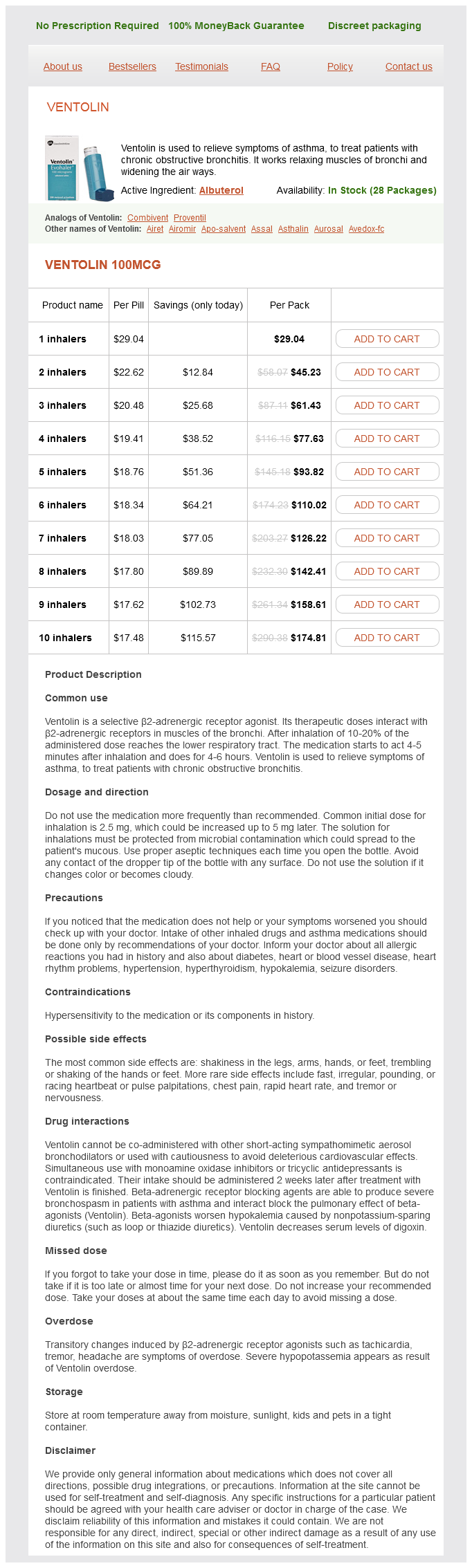
Albuterol Dosage and Price
Ventolin 100mcg
- 1 inhalers - $29.04
- 2 inhalers - $45.23
- 3 inhalers - $61.43
- 4 inhalers - $77.63
- 5 inhalers - $93.82
- 6 inhalers - $110.02
- 7 inhalers - $126.22
- 8 inhalers - $142.41
- 9 inhalers - $158.61
- 10 inhalers - $174.81
Farstad asthma symptoms middle age buy albuterol 100 mcg free shipping, the role of blood platelets in coronary atherosclerosis and thrombosis, Scand. Chesebro, Role of platelets and thrombosis in coronary atherosclerotic disease and sudden death, J. Schomig, Changes in membrane glycoproteins of circulating platelets after coronary stent implantation, Heart 76 (1996) 166172. Schomig, Prospective evaluation of hemostatic predictors of subacute stent thrombosis after coronary Palmaz-Schatz stenting, J. Kaushansky, Historical review: megakaryopoiesis and thrombopoiesis, Blood 111 (2008) 981986. Jaffe, Stimulation of endothelial cell prostacyclin production by thrombin, trypsin, and the ionophore A 23187, J. Identification as nitric oxide and role in the control of vascular tone and platelet function, Biochem. Moncada, Endogenous nitric oxide inhibits human platelet adhesion to vascular endothelium, Lancet 2 (1987) 10571058. Vallance, Effects of S-nitroso-glutathione in the human forearm circulation: evidence for selective inhibition of platelet activation, Cardiovasc. Moncada, Inhibition of platelet activity by S-nitrosoglutathione during coronary angioplasty, Lancet 344 (1994) 14581460. Avcu, In vitro effect of sodium nitrite on platelet aggregation in human platelet rich plasma- preliminary report, Eur. Leon, Increased restenosis in diabetes mellitus after coronary interventions is due to exaggerated intimal hyperplasia A serial intravascular ultrasound study, Circulation 95 (1997) 13661369. Potential biologic determinants and role of intimal hyperplasia, Circulation 79 (1989) 13741387. Simon, Molecular basis of restenosis and drug-eluting stents, Circulation 111 (2005) 22572273. Virmani, Drug-eluting stent and coronary thrombosis: biological mechanisms and clinical implications, Circulation 115 (2007) 10511058. Clowes, Pharmacologic inhibition of nitric oxide synthases and cyclooxygenases enhances intimal hyperplasia in balloon-injured rat carotid arteries, J. Sessa, Direct evidence for the importance of endothelium-derived nitric oxide in vascular remodeling, J. Edelman, Local drug delivery: an emerging approach in the treatment of restenosis, Vasc. Smith, Incorporation of nitric oxide-releasing crosslinked polyethyleneimine microspheres into vascular grafts, J. Evidence that reduction of the nitroprusside anion and cyanide loss are required, Biochem. Lincoff, Local delivery of nitric oxide from an eluting stent to inhibit neointimal thickening in a porcine coronary injury model, Yonsei Med. Loscalzo, Nitric oxide donors and cardiovascular agents modulating the bioactivity of nitric oxide: an overview, Circ. Webb, A comparison of organic and inorganic nitrates/nitrites, Nitric Oxide 26 (2012) 229240. Williams, Generation of nitric oxide from S-nitrosothiols using protein-bound Cu2+ sources, Chem. Jaffe, Acute myocardial infarction and renal dysfunction: a high-risk combination, Ann. Seifalian, Nitric oxide donors for cardiovascular implant applications, Small 9 (2013) 2235. Shanley, Nitric oxidereleasing biopolymers inhibit thrombus formation in a sheep model of arteriovenous bridge grafts, J. Carruba, Mitochondrial biogenesis in mammals: the role of endogenous nitric oxide, Science 299 (2003) 896899. Mcgoron, Biodegradable magnesium alloys: a review of material development and applications, J. Gladwin, Nitrite reduction to nitric oxide by deoxyhemoglobin vasodilates the human circulation, Nat. Gladwin, Deoxymyoglobin is a nitrite reductase that generates nitric oxide and regulates mitochondrial respiration, Circ. Harrison, Reduction of nitrite to nitric oxide catalyzed by xanthine oxidoreductase, J. Fago, Generation of nitric oxide from nitrite by carbonic anhydrase: a possible link between metabolic activity and vasodilation, Am. Airaksinen, Two-year follow-up after percutaneous coronary intervention with titanium-nitride-oxide-coated stents versus paclitaxel-eluting stents in acute myocardial infarction, Ann. Ormiston, Evaluation of the second generation of a bioresorbable everolimus-eluting vascular scaffold for the treatment of de novo coronary artery stenosis: 12-month clinical and imaging outcomes, J. Zhu, Bioabsorbable zinc ion induced biphasic cellular responses in vascular smooth muscle cells, Sci. Cardiovascular implants find wide clinical applications, making a great contribution to the treatment of cardiovascular diseases. However, they performed not so well in long-term clinical studies [4], also considering that the released drug from the stent surface delays endothelialization and triggers late thrombosis.