
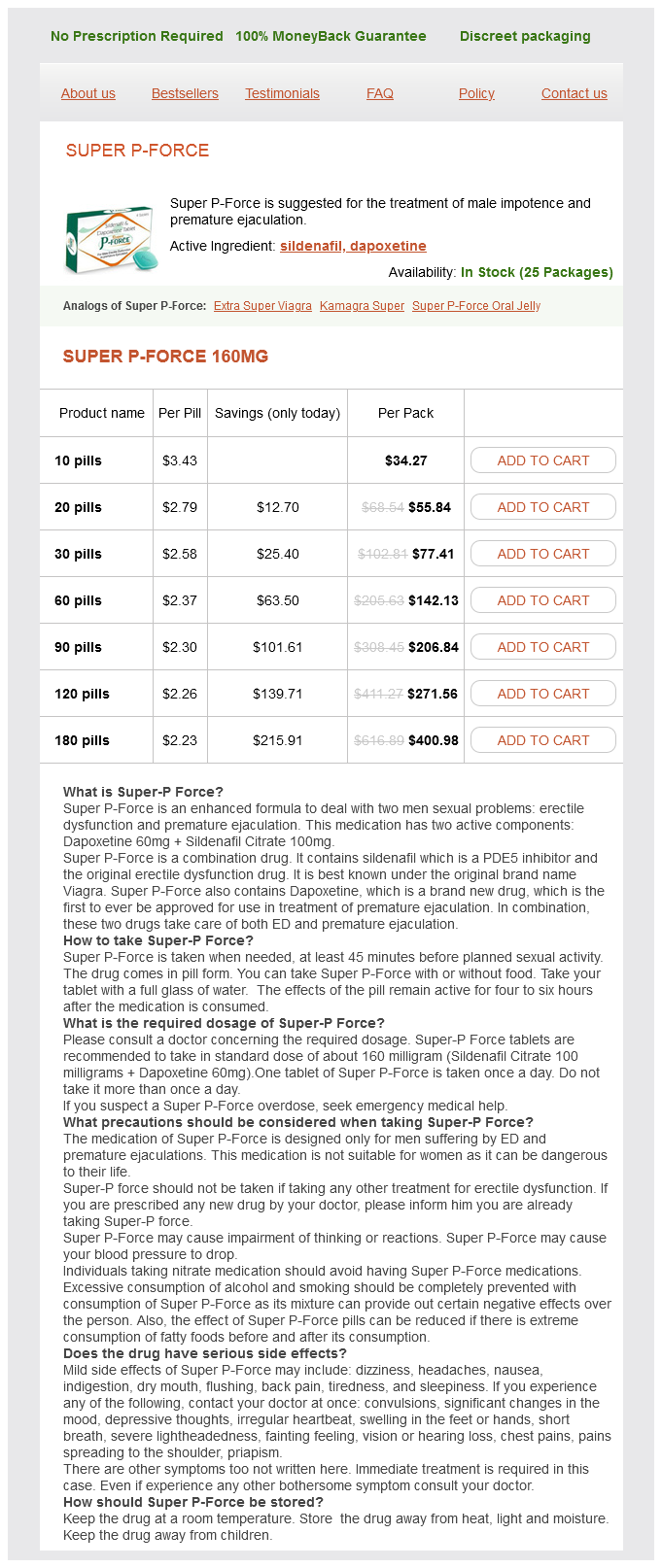
General Information about Super P-Force
Super P-Force is a safe and efficient remedy that may assist men overcome these sexual issues and revel in a fulfilling intercourse life. Its dual-action formulation works on the bodily and psychological elements of sexual performance, making it a highly most well-liked alternative amongst males.
Super P-Force comes in a single tablet type and is taken orally with a glass of water. It starts to work inside an hour of consumption and may final for up to 4-6 hours, providing ample time for spontaneous sexual exercise. It is really helpful to take the treatment on an empty abdomen for optimal outcomes.
The second lively ingredient, Dapoxetine, is a selective serotonin reuptake inhibitor (SSRI) that helps to delay ejaculation and enhance control over ejaculation. This helps males to last longer in bed, giving them and their partners an opportunity to reach orgasm together, resulting in a extra fulfilling sexual expertise. Dapoxetine has been particularly designed to deal with PE and has been discovered to be extremely efficient in medical research.
Erectile dysfunction is a sexual dysfunction the place a man is unable to realize or keep an erection for satisfactory sexual activity. This condition impacts tens of millions of males worldwide and might have a big impact on their self-esteem and relationships. Premature ejaculation, on the other hand, is a condition the place a person ejaculates too shortly throughout sexual intercourse, leaving both companions dissatisfied and frustrated.
As with any treatment, Super P-Force might cause some mild unwanted effects, together with headache, dizziness, nasal congestion, and flushing. These unwanted aspect effects are often short-lived and subside on their own. However, if they persist or turn into severe, it's advisable to hunt medical assist.
In conclusion, Super P-Force is a secure and effective resolution for males struggling with ED and PE. Its distinctive mixture of two active ingredients makes it a one-of-a-kind medication that addresses both these situations simultaneously. With regular use, males can regain their confidence in the bedroom and lead a wholesome and satisfying intercourse life once again. So, do not let these sexual issues have an effect on your relationship - give Super P-Force a attempt to expertise the difference for your self.
The first energetic ingredient, Sildenafil Citrate, is a PDE5 inhibitor that helps to relax the blood vessels within the penile region, enabling a greater circulate of blood to the penis throughout sexual arousal. This results in a agency and lasting erection, permitting men to interact in longer and more satisfying sexual activity. Sildenafil Citrate has been used in the well-liked ED medication, Viagra, and has a proven monitor report of successfully treating ED.
Super P-Force is a revolutionary treatment that has been designed to tackle two of probably the most irritating problems affecting males of all ages - erectile dysfunction (ED) and premature ejaculation (PE). It is a combination drug, which incorporates two active ingredients, Sildenafil Citrate and Dapoxetine, to successfully handle each these issues.
It is crucial to consult a doctor before beginning Super P-Force or any other ED or PE medicine. This is especially important for men who've a historical past of heart disease, low or hypertension, liver or kidney issues, or are taking other drugs that may interact with Super P-Force. Super P-Force isn't suitable for men beneath the age of 18 and shouldn't be taken by ladies.
Thus a low oral bioavailability of inhaled corticosteroids is desirable erectile dysfunction causes heart purchase super p-force american express, ranging from 1% for fluticasone propionate to 26% for 17-beclomethasone monopropionate. In contrast to oral absorption, most drug deposited in the lung will be absorbed systemically and is not subjected to first-pass hepatic metabolism. Deposition and thus absorption from the lung is more a function of the efficiency of the delivery device than the properties of the drug itself. Most of the inhaled corticosteroids are (~70%) bound to plasma proteins and have half-lives of 3 to 8 hours owing to high extraction and metabolism by the liver. The efficacy of inhaled corticosteroids in asthma has been shown in many studies, usually with comparable benefits to systemic steroids with fewer side effects. Inhaled corticosteroids reduce symptoms,50 frequency of exacerbations, airway hyperresponsiveness,51 airway inflammation, and asthma mortality. Aminophylline is two theophylline molecules combined with a 1,2 ethanediamine moiety. Roflumilast is a halide-modified benzamide molecule synthesized from 3-(cyclopropylmethoxy)4-hydroxybenzaldehyde. Adverse Effects Many studies report no or minimal side effects on adrenal function, bone density,45 or subcapsular cataracts, whereas some studies contend a dose-dependent effect of all inhaled steroids on these parameters. Mechanism and Metabolism Methylxanthines have antiinflammatory and bronchodilating effects. Plasma concentrations of mometasone furoate and a metabolite of ciclesonide increased with ketoconazole administration. Clinical Application Common Applications Inhaled corticosteroids are commonly recommended as initial therapy for asthma. The introduction of inhaled steroids in the 1970s revolutionized therapy for bronchospastic diseases by allowing the delivery of steroids directly to the airway with a reduction in the systemic toxicity of chronic oral steroid ingestion. Although the precise mechanisms of asthma remain poorly understood, a significant component of asthma involves a complex interplay between inflammatory and structural cells of the airway. Theophylline is also 8-hydroxylated to 1,3-dimethyluric acid, which is subsequently N-demethylated to 1-methyluric acid. Many drug classes affect its metabolism and thus serum concentrations (see later text). Drug Interactions Many medications can increase the serum concentrations of theophylline, thereby enhancing their potential for toxicity; these medications include cimetidine, mexiletine, ticlopidine, propranolol, ciprofloxacin, alcohol, allopurinol, disulfiram, erythromycin, and estrogens. Cigarette and marijuana smoking and medications that induce liver metabolic enzymes. Clinical Pharmacology Pharmacokinetics, Pharmacodynamics, and Therapeutic Effects Theophylline is 40% protein bound with a volume of distribution of 0. Oral theophylline is well absorbed from the gastrointestinal tract, resulting in 90% to 100% bioavailability with peak serum levels occurring within 1 to 2 hours of ingestion. Sustained-release formulations are available owing to the relatively short half-life of 8 hours in healthy adults. The elimination half-life varies widely-from 30 hours in premature neonates to 3. The intravenous dose required to achieve a therapeutic concentration of 10 to 20 µg/mL varies fourfold in an otherwise healthy adult population. For rapid treatment of acute bronchospasm a loading dose followed by maintenance infusion is frequently used. Following oral administration of roflumilast, the time to peak plasma concentration is 1 hour, with nearly 99% protein bound. With daily dosing, steady-state levels are achieved in 4 days with a mean plasma half-life of 17 hours. However, methylxanthines are also respiratory stimulants and have been evaluated in central apnea, obstructive sleep apnea, and periodic breathing (Cheyne-Stokes respiration). Adverse Effects Adverse reactions are uncommon at serum theophylline levels below 20 µg/mL. Adverse reactions at serum concentrations between 20 and 25 µg/mL include nausea, vomiting, diarrhea, headache, and insomnia. Symptoms of overdosage at concentrations more than 30 µg/mL include seizures, tachyarrythmias, congestive heart failure, tachypnea, hematemesis, and reflex hyperexcitability. Methylxanthine use during anesthesia was also problematic owing to the release of catecholamines in combination with volatile anesthetics that sensitized the myocardium to their arrythmogenic effects. Clinical Application Common Applications Theophylline is among the most widely prescribed medication for the treatment of asthma worldwide, but it is recommended as second- or third-line therapy behind inhaled corticosteroids and inhaled agonists because of its potential for systemic toxicity. By the 1980s several studies reported that inhaled 2 agonists were superior to aminophylline or theophylline in acute asthmatic exacerbations. They are so named owing to their source from leukocytes and the presence of three conjugated double bonds in their structure. Independent medicinal chemistry strategies were used to identify both of the antagonists in current clinical use (Table 30. This enzyme is inhibited by the only 5-lipoxygenase inhibitor approved for asthma, zileuton. An investigational intravenous formulation of montelukast has an onset within 10 minutes and improves bronchoconstriction for at least 2 hours. Emerging biologic therapies target specific cytokines, particularly those of the Th2 subtype. These biologics are reserved for patients with severe asthma, but a significant clinical challenge remains in identifying the molecular asthmatic endotype of a given patient who could potentially benefit from these therapies. Omalizumab was the first clinically available biologic in this class and is a recombinant human IgG1 monoclonal antibody (150 kDa) that selectively binds to human IgE. One IgE molecule has two antigenic binding sites for omalizumab, and omalizumab in turn has two antigen binding sites; thus IgE/anti-IgE complexes are formed with molecular masses of 500 to 1000 kDa. Clinical Pharmacology Pharmacokinetics, Pharmacodynamics, and Metabolism Montelukast and zafirlukast are rapidly absorbed after oral administration and are more than 99% bound to albumin.
A single dose of milrinone facilitates separation from cardiopulmonary bypass in patients with pre-existing left ventricular dysfunction erectile dysfunction drugs in canada 160 mg super p-force with amex. Milrinone increases flow in coronary artery bypass grafts after cardiopulmonary bypass: a prospective, randomized, double-blind, placebo-controlled study. Milrinone for the treatment, of cerebral vasospasm after aneurysmal subarachnoid hemorrhage. Comparison of inhaled and intravenous milrinone in patients with pulmonary hypertension undergoing mitral valve surgery. Milrinone use is associated with postoperative atrial fibrillation after cardiac surgery. Randomised double-blinded comparison of phenylephrine vs ephedrine for maintaining blood pressure during spinal anaesthesia for non-elective Caesarean section*. The effects of phenylephrine on right ventricular performance in patients with pulmonary hypertension. The effect of phenylephrine and norepinephrine in patients with chronic pulmonary hypertension. New York State guidelines on the topical use of phenylephrine in the operating room. Comparison of two dose regimens of arginine vasopressin in advanced vasodilatory shock. Comparing two different arginine vasopressin doses in advanced vasodilatory shock: a randomized, controlled, open-label trial. Hemodynamic and metabolic effects of low-dose vasopressin infusions in vasodilatory septic shock. Release of endogenous vasopressors during and after cardiopulmonary resuscitation. Randomised comparison of epinephrine and vasopressin in patients with out-of-hospital ventricular fibrillation. Usefulness of vasopressin administered with epinephrine during out-of-hospital cardiac arrest. Plasma vasopressin levels and urinary sodium excretion during cardiopulmonary bypass with and without pulsatile flow. Terlipressin versus norepinephrine to correct refractory arterial hypotension after general anesthesia in patients chronically treated with renin-angiotensin system inhibitors. The effect of vasopressin on gastric perfusion in catecholamine-dependent patients in septic shock. The effects of vasopressin on systemic hemodynamics in catecholamine-resistant septic and postcardiotomy shock: a retrospective analysis. Does arginine vasopressin influence the coagulation system in advanced vasodilatory shock with severe multiorgan dysfunction syndrome Effects of equipotent ephedrine, metaraminol, mephentermine, and methoxamine on uterine blood flow in the pregnant ewe. Fetal and maternal effects of phenylephrine and ephedrine during spinal anesthesia for cesarean delivery. A quantitative, systematic review of randomized controlled trials of ephedrine versus phenylephrine for the management of hypotension during spinal anesthesia for cesarean delivery. Goal-directed haemodynamic therapy and gastrointestinal complications in major surgery: a meta-analysis of randomized controlled trials. Levosimendan for the treatment of acute severe heart failure: a meta-analysis of randomised controlled trials. Allhavesideeffects,largelycardiovascular, and important drug interactions that must be considered in the perioperativeperiod. The use of combination therapy is not new; it originates from the mid-1960s when studies showed the efficacy of fixed doses of reserpine,hydrochlorothiazide,andhydralazine. One of the earliest treatments for hypertension was that described by Pauli using the sedative and hypotensive properties of sodium thiocyanate to obtain relief from the subjective symptomsofhypertension. The antihypertensive effect of adrenergic neuron blockers (bretylium being the first) depends on inhibition of transmitter release from adrenergic nerve terminals in response to sympathetic nerveimpulses. Although chlorothiazide had only weak antihypertensive effects, its use was associated with a marked potentiation of the effect of other antihypertensive drugs. Basedonthesemechanisms,thereare a number of potential sites of action for antihypertensive agents (Table26. They also reduce the increase in intracellular Ca2+ in response to membrane depolarization and the secondary Ca2+-induced Ca2+ release fromintracellularstores. However, they are more abundant in bronchial and peripheral vascular smooth muscle, where they lead to bronchodilation and vasodilation, respectively(seeChapter30). In contrast to 1 and 2 adrenoceptors, activation of 3 leads to a decrease in inotropic state of the myocardium via a Gi protein dependentpathway. A third class of blockers (including metoprolol and carvedilol) have an additional property in reversing the effects of cardiac remodeling. Other blockers stabilize the receptor in the inactivated state, thus leading to receptor upregulation rather than the desensitization and downregulationseen with xamoterol. Thus,the1 selective blockers (acebutolol, atenolol, bisoprolol, celiprolol, esmolol, xamoterol) diminish detrimental cardiac remodeling while preserving the protective effects of 2 activation. Thepartialinverseagonists(metoprolol and nebivolol) might reduce receptor desensitization while maintaining functional receptorresponsiveness. Partial agonists (pindolol) result in less resting bradycardia and someperipheralvasodilation.
Super P-Force Dosage and Price
Super P-Force 160mg
- 10 pills - $34.27
- 20 pills - $55.84
- 30 pills - $77.41
- 60 pills - $142.13
- 90 pills - $206.84
- 120 pills - $271.56
- 180 pills - $400.98
Achalasia is a disorder in which the lower esophageal sphincter loses the ability to relax in response to swallowing erectile dysfunction pills at gnc order super p-force with a mastercard. The strength of stimulation is proportional to the amount of secreted norepinephrine, which causes a range of inhibition from slight to very strong inhibition capable of causing a cessation of movement. Key hormones, along with their stimuli, site of secretion, and actions, are listed in Table 31. The myenteric plexus extends throughout the entire length of the gut as a linear chain of interconnected neurons. Lying within intestinal smooth muscle, the myenteric plexus focuses on muscle control. Upon stimulation, the plexus causes an increase in gut wall tone and in intensity of rhythmical contractions. Although it is associated mostly with excitatory muscle activity, there is also an inhibitory function of the myenteric plexus. Possibly through secretion of vasoactive intestinal polypeptide (or some other inhibitory peptide), the myenteric plexus can inhibit intestinal sphincter muscles such as the pyloric sphincter and the ileocecal valve, which normally impede the movement of gut contents. Parasympathetic Stimulation the cranial and sacral division of the parasympathetic system stimulates activity of the enteric nervous system. The cranial parasympathetic nerves originate almost entirely in the vagus nerves; however, some also exist at the mouth and pharyngeal regions of the tract. These nerves innervate the esophagus, stomach, pancreas, and a part of the intestines. From the chains, sympathetic nerve fibers enter various outlying sympathetic ganglia such as the celiac ganglia and other mesenteric ganglia. This system supplies and drains multiple organs, including the gut, spleen, pancreas, and liver. The arterial supply includes the celiac, superior mesenteric, and inferior mesenteric arteries. Venous drainage of the visceral organs occurs via the splenic, superior mesenteric, and inferior mesenteric veins. Splanchnic blood reaches the liver via the portal vein, which is a confluence of the splenic and superior mesenteric veins. Stomach Emptying the rate of stomach emptying varies depending on the signals from the stomach and the duodenum. The duodenum is the primary regulator of the rate at which chyme enters the small intestine. Enterogastric Nervous Reflex the enterogastric nervous reflex of the duodenum inhibits stomach emptying. Food entering the duodenum elicits various nervous reflexes that regulate the rate of stomach emptying. Factors initiating this reflex include (1) duodenal distention, (2) irritation of duodenal mucosa, (3) acidity of chyme, (4) osmolality of chyme, and (5) presence of certain breakdown products in chyme. Altogether, these affect stomach emptying by inhibiting the propulsive contractions of the pyloric pump and by increasing the tone of the pyloric sphincter. The existence of a reflex arc has been suggested in which stimulation of the celiac plexus results in inhibition of sympathetic activity, leading to increased vagal tone and bradycardia. However, bradycardia in response to mesenteric traction has not been consistently demonstrated in controlled studies. Secretory Functions the secretory function of the digestive glands is highly specialized to correspond with the food type and amount of food present in the gut. Other glands of the gut secrete in response to local neural and hormonal stimuli rather than as a result of nerve innervation. Sympathetic stimulation to alimentary tract glandular secretion is less straightforward than parasympathetic stimulation. Sympathetic stimulation has a dual effect, causing a slight increase in glandular secretion if stimulated alone, but with preexisting parasympathetic or hormonal stimulation, sympathetic stimulation reduces secretions. Gastric Secretions the stomach mucosa contains oxyntic or gastric glands and pyloric glands. The stomach lacks such a highly increased surface area, allowing only the absorption of highly lipid-soluble substances, such as alcohol and aspirin, through its epithelium. Villi and the brush border of microvilli contribute to the high absorptive properties of the small intestine by adding to the total absorptive area. Daily absorption from the small intestine consists of several hundred grams of carbohydrates, 100 g or more of fat, 50 to 100 g of amino acids, 50 to 100 g of salt ions, and 7 to 8 L of water. Gastrin is released into the blood and rapidly transported to the enterochromaffin-like cells of the stomach. This rapid transport is a result of the rapid mixing of gastric juices in the stomach. This cotransporter uses an electrochemical potential difference instead of adenosine triphosphate to function. The pumping of Na+ through the basolateral membrane into the extracellular compartment by sodium-potassium adenosine triphosphatase uses adenosine triphosphate to reduce Na+ within the cell. The cotransporter allows Na+ to move down its concentration gradient into the cell from the intestinal lumen, along with a glucose molecule. After glucose enters cells, it moves by facilitated diffusion into the bloodstream. The initial active transport of Na+ out of the epithelial cell provides the electrochemical motive force for moving glucose from the intestinal lumen into the bloodstream.